Home Energy Audits
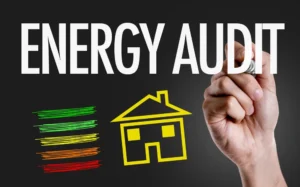
A home energy audit is a structured evaluation of how your house performs as a complete system.
Rather than focusing on a single piece of equipment, an audit looks at how all the parts of the home work together, including:
- Air leakage and drafts
- Insulation levels and continuity
- Heating and cooling systems
- Ventilation and moisture movement
- Room-to-room comfort differences
The goal is to understand why a home feels the way it does — cold rooms, uneven temperatures, or higher-than-expected energy bills — and to identify practical, prioritized improvements.
Blower door testing
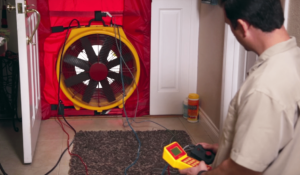
A blower door test is a core part of a proper energy audit.
During the test, we install a calibrated fan in an exterior doorway to temporarily depressurize the home. This allows us to measure how much air leaks in and out, identify specific leakage areas, and quantify results using ACH50 (air changes per hour).
In many homes, excessive air leakage means heated air is replaced multiple times per hour — leading to drafts, discomfort, and higher energy costs.
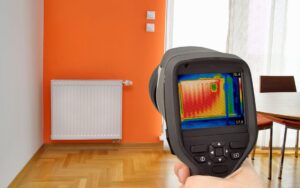
Thermal imaging during the test can also reveal temperature differences and hidden air leaks that are not visible to the naked eye. Blower door testing is often required for new construction and major renovations to meet building code requirements.
What’s included in our energy audits
Every home is different, but a typical energy audit includes:
-
Blower door test and air-leakage measurement
-
Thermal imaging with a FLIR camera
-
Inspection of insulation and air barriers
-
Review of heating, cooling, and hot water systems
-
Identification of comfort and moisture concerns
We focus on clear explanations and practical recommendations to improve comfort and efficiency.
Thermal imaging helps reveal missing insulation, thermal bridging, and hidden air leaks.
What homeowners gain from an energy audit
Think of an energy audit as a report card on your home’s health.
An audit helps answer common questions, such as:
- Why does one room feel colder than the rest of the house?
- Why are energy bills higher than expected?
- Where should improvements actually start?
- Will a heat pump perform well in this home?
Homeowners often use an audit to:
- Improve comfort and consistency throughout the house
- Plan insulation or air-sealing work
- Support HVAC or heat pump design decisions
- Meet building code or program requirements
Energy audits and heat pumps
Energy audits pair naturally with heat pump projects.
Because heat pumps are sensitive to air leakage and insulation quality, an audit can:
- Improve system sizing accuracy
- Reduce future comfort complaints
- Lower long-term operating costs
- Identify improvements that should happen before or alongside installation
Even if a heat pump is already installed, an audit can help explain performance issues and identify opportunities for optimization.
Service option
Home Energy Audit – $500 (includes blower door testing)
- Full home walkthrough
- Blower door test and air-leakage measurement
- Diagnostic discussion of findings
- Practical, prioritized recommendations
Blower Door Test Only – $300
- Available when air-leakage testing is needed for code compliance, verification, or documentation without a full energy audit.